
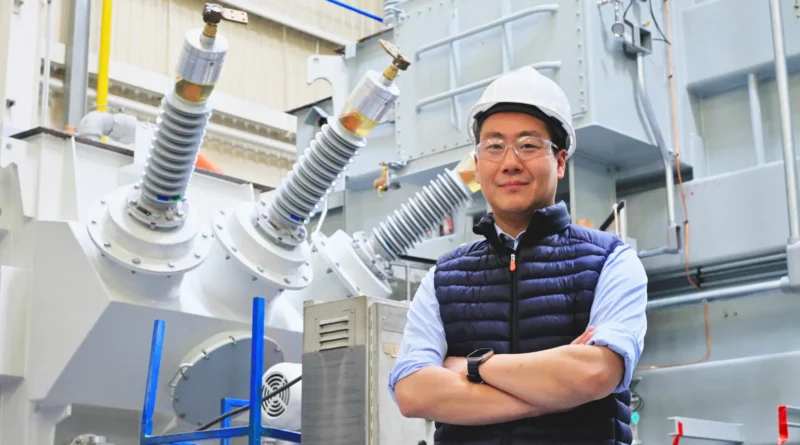
A Scientist’s Bet on Fixing the Grid’s Oldest, Most Ignored Problem
The lifespan of large power transformers have created problems for the United States power grid for a long time—each averaging around 38-40 years of life—but all along, the latent issue has been the time to replace one.
“There’s a missing data layer in this industry, which leads to a garbage-in, garbage-out problem,” said Joseph Kao, the founder and CEO of Magnefy.
Magnefy is a startup that builds non-invasive magnetic sensors which clamp onto transformers and other grid equipment to detect potential failures. As the company has grown, Kao’s path has been a long and windy road, taking on the challenges of finding a viable market, gaining the trust of customers and learning to explain technical science to people who may not understand how it works.
Finding the Right Problem
Kao’s path to Magnefy began a decade earlier, in materials science and hardware research that had little to do with the power grid. He earned a PhD at UC Berkeley researching biodegradable plastics before taking on engineering roles at Apple, Meta and Dow. His decision to enter the energy industry, however, came from his conversations.
“I conducted so many interviews, just talking to potential customers and different stakeholders in the value chain, and realized there’s really this increasing failure rate for this equipment,” he said.
During a program at Stanford, Kao took nearly three entrepreneurship classes centered on market research. He spent much of the process talking to people in the energy industry to understand which problems were worth solving, and which were not worth his time.. Magnefy did not begin to feel like a real business until about a year and a half into the process.
Then, the company secured its first paid pilot projects.
“That’s where I really saw, okay, this is turning real,” he said.
Magnefy was not Kao’s first business idea. He initially set out to recycle and repurpose used lithium-ion batteries, speaking with hundreds of people in the industry before questioning whether the idea was worth pursuing.
“We always ask: is it a vitamin or a painkiller?” he said. “Battery recycling, because of the volume, the regulations, and the market dynamics here in the U.S., is more like a vitamin—and it’s even worse than a vitamin, because it’s not even really what people want right now.”
Between 2023 and 2025, falling prices for new lithium-ion batteries made recycling and repurposing used batteries less financially attractive.
“The reason is simple,” Kao said. “New batteries were getting so cheap, and there’s no regulation in the U.S. to really promote that kind of circular economy and recycling for batteries.”
From Research to Real-World Solutions
Kao’s conversations with energy companies eventually led him toward Magnefy’s current business.The idea came from the problem that continued to be exposed: companies were more concerned about monitoring the aging equipment already in use, rather than the recycling of batteries.
Although he had many conversations , there were a few in particular that helped shape his decision the most.
One was Key Capture Energy: a developer of renewable energy and battery storage projects, staff described transformer failure rates that were higher than expected. Kao also spoke with insurance companies, including Munich Re, HSB and FM, that cover industrial equipment and assess the risks associated with transformer assets.
“They told me their underwriting and risk-assessment process is completely broken for transformer assets, and the data they’ve been relying on just isn’t working,” Kao said.
Building Trust in Transformer Monitoring
Although Kao had identified a problem that companies wanted to solve, convincing customers to trust a startup with critical infrastructure became the largest challenge. Utilities and data centers cannot easily take risks on unproven products, particularly when the equipment involved is essential to their operations.
Kao’s approach was to work with established manufacturers and use studies and proof-of-concept projects to demonstrate that Magnefy’s technology worked.
“It definitely helps to show people that we’ve done studies and proof-of-concept and really demonstrate the results,” he said. “People see that as credible, trusted by a reputable company.”
Despite his technical background, Kao said that developing the technology was not necessarily the hardest part of building Magnefy. Learning how to communicate its value to potential customers proved just as important.
“People don’t buy a technology,” he said. “They buy a solution that solves a problem.”
Kao describes Magnefy’s sensors as something that listens to “the heartbeat of the asset.” Rather than focusing on the science behind the technology, he wants customers to understand how it can help them identify problems with equipment before failures occur.
Advice to Entrepreneurs
Kao also directs his experiences toward young, aspiring founders, emphasizing the challenges that come with turning an idea into a functioning business. He said that having work experience before founding a company can help entrepreneurs understand the problems they are trying to solve and whether customers will actually pay for a solution.
“The moment you start building a company, especially after you take venture capital money, the reality hits and the clock starts ticking,” he said. “You almost don’t have time to make too many mistakes.”
Kao said that having an interesting idea is not enough to build a successful company. Founders must also understand their market and determine whether their business can generate revenue.
“Is there a market, and can you make money?” he said. “Once you understand those two things, the technology and how you communicate it to customers are both secondary.”