
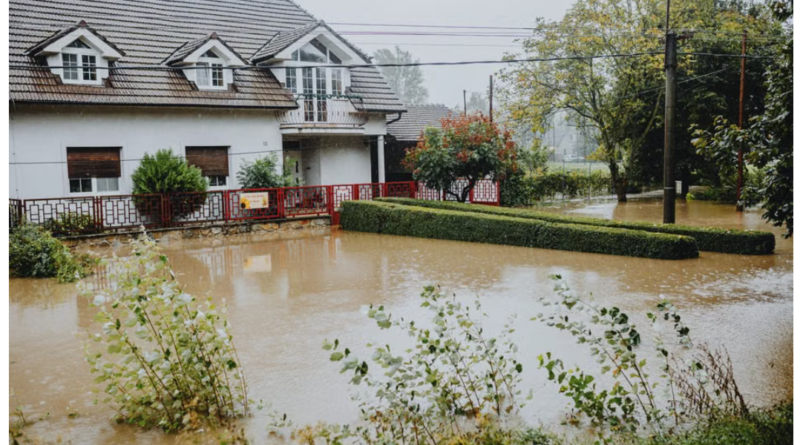
Navigating Property Damage Insurance Claims
ew events are as disruptive as property damage, whether from a sudden storm, an unexpected fire, or a burst pipe. When such incidents occur, navigating the complexities of an insurance claim can feel overwhelming for policyholders. This is where a skilled and knowledgeable insurance adjuster becomes indispensable.
For those considering a career in this critical field, or simply seeking to understand the professionals who help restore lives, comprehending the intricacies of property damage insurance claims is essential. Adjusters play a pivotal role, acting as the bridge between policyholders and insurance companies. They assess losses, interpret policy language, and facilitate the path to recovery.
In this guide, we will delve into property damage claims from an adjuster’s perspective. We will clarify the different types of adjusters—staff, independent, and public—and outline their unique responsibilities. Our aim is to shed light on how these professionals evaluate damage, manage the settlement process, and the crucial skills required to excel in this dynamic profession. By understanding these roles, we empower both aspiring adjusters and policyholders to navigate the claims process with confidence.
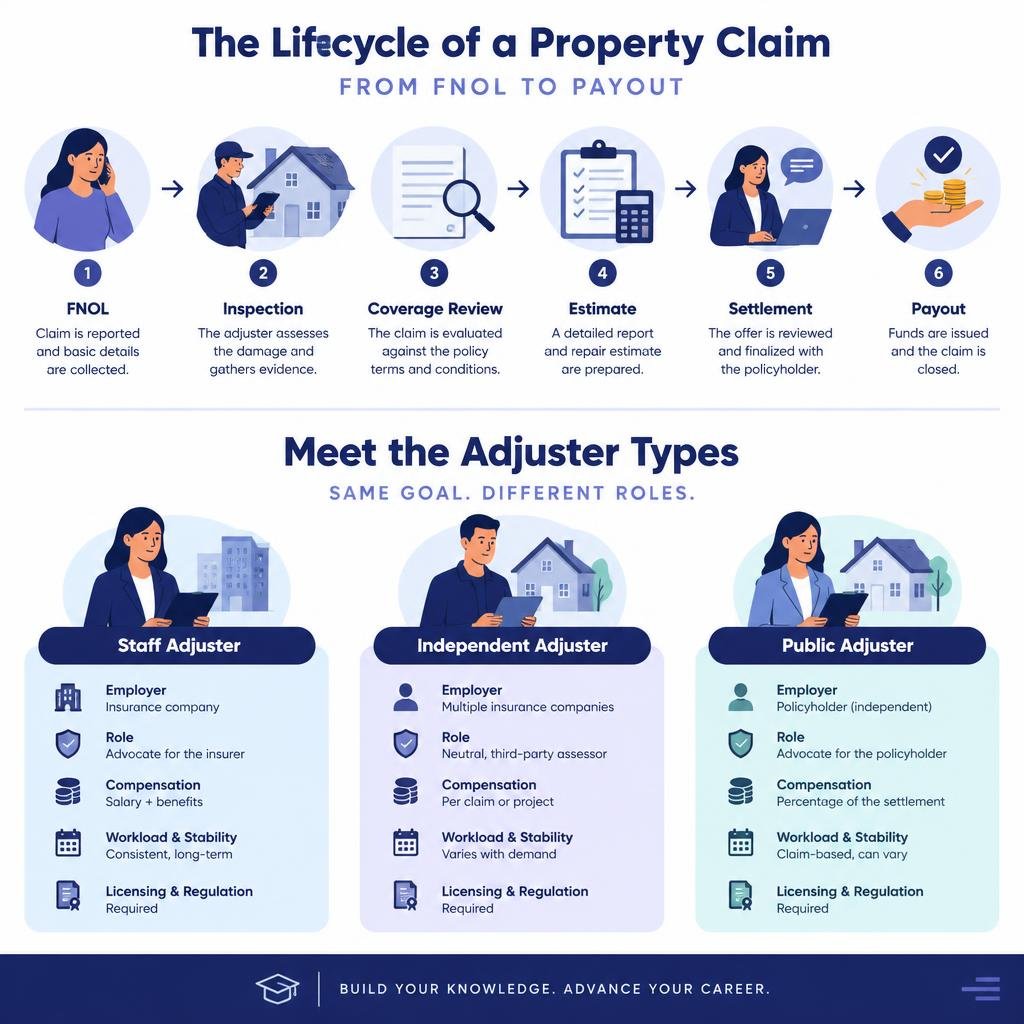
The insurance claims industry is supported by a diverse group of professionals, each playing a distinct role in the process of claim representation and resolution. While all adjusters are involved in assessing damage and determining coverage, their allegiances and operational structures vary significantly. Understanding these distinctions is crucial for anyone looking to enter the field or for policyholders seeking assistance. At the core, an adjuster’s primary function is to investigate claims, but whether they act as insurer advocates or policyholder representatives dictates their approach and responsibilities. The importance of adjuster licensing cannot be overstated, as it ensures a baseline of knowledge and adherence to state-specific regulations and code compliance.
The most common types of adjusters working directly for insurance companies are staff adjusters and independent adjusters. Staff adjusters are direct insurer employees, receiving a consistent salary, benefits, and often a more structured work environment. Their primary allegiance is to their employing insurance carrier, and their work is guided by specific carrier guidelines and internal policies. They typically handle a steady stream of claims, often specializing in particular lines of business like auto, property, or workers’ compensation. Their career path often involves internal promotions and management roles within the company.
Independent adjusters, by contrast, are third-party contractors hired by insurance companies or independent adjusting (IA) firms on a per-claim or daily rate basis. While they also represent the insurer, they are not direct employees. This setup offers greater flexibility for both the adjusters and the carriers. For adjusters, it means the potential for higher earnings, particularly during catastrophe response events, where they are often deployed rapidly to affected areas. Independent adjusters might work for multiple carriers, gaining diverse experience. Their workload can be highly variable, with periods of intense activity during major storms or other widespread incidents, followed by quieter times. They are crucial for claim triage during high-volume periods, helping insurers manage surges in demand without expanding their permanent staff.
Adjuster Type Primary Employer/Client Role & Allegiance Compensation Structure Workload & Stability Licensing & Regulation Staff Adjuster Insurance Company Represents the insurer; salaried employee Salary + Benefits Stable, consistent workload Licensed by state, often exempt from some requirements Independent Adjuster Independent Adjusting Firm (contracted by insurers) Represents the insurer; contractor for multiple carriers Fee-based per claim or daily rate Variable, often high during catastrophes Licensed by state, often requires DHS/multi-state licensing Public Adjuster Policyholder Represents the policyholder; advocate for insured Percentage of settlement Variable, based on client acquisition and claims Licensed by state, strict ethical guidelines, bonding Company Staff vs. Independent Adjusters
The Role of a Licensed Public Adjuster
A licensed public adjuster stands apart from staff and independent adjusters because their allegiance is solely to the policyholder. They are hired directly by the insured to represent their interests during the claims process, advocating for the best possible settlement. This role is particularly valuable when policyholders feel overwhelmed, believe their claim has been underpaid, or faces a denial. Public adjusters handle everything from initial damage appraisal and documentation to complex claim negotiation with the insurance company.
Their fee structures are typically contingency-based, meaning they receive a percentage of the final settlement. This aligns their financial interests directly with the policyholder’s, as they only get paid if the policyholder receives a settlement. Given their unique position, public adjusters are often subject to stringent state bonding and licensing requirements, along with strict ethical guidelines, to protect consumers. They bring a professional level of expertise to policyholder representation, ensuring that all aspects of the claim are thoroughly documented and presented, often leading to significantly higher payouts for the insured.
How Adjusters Evaluate Property Damage Insurance Claims

When property damage occurs, the adjuster’s role is to meticulously evaluate the scope of loss and determine its causation. This involves more than just looking at damaged items; it’s a detailed investigation into how the damage occurred, whether it’s covered by the policy, and the extent of necessary repairs or replacement. Key to this process is distinguishing between sudden loss, which is typically covered, and gradual seepage or wear and tear, which are often exclusions. Adjusters must also be aware of any specific endorsements that might alter standard policy coverage.
Policy Coverage and Causation Analysis
The first critical step in evaluating any property damage claim is a thorough review of the policy itself. Adjusters examine the declarations page to understand the specific coverages, limits, and deductibles applicable to the claim. The core task then becomes peril verification: determining if the cause of loss is a covered peril under the policy. For instance, while most policies cover sudden and accidental water damage, they often exclude damage from continuous or repeated leakage. Similarly, wind coverage might be standard, but damage from floodwaters (even if caused by a hurricane) is typically excluded unless there’s a separate flood insurance policy.
This causation analysis is paramount. Was the roof damage caused by hail (covered) or simply old age and lack of maintenance (not covered)? Did the water damage result from a sudden pipe burst (covered) or a long-standing leak (often excluded)? Understanding these nuances is vital for accurate claim handling. Adjusters must also calculate the deductible, which is the amount the policyholder is responsible for before the insurance coverage kicks in. For those looking to deepen their understanding of the intricate details involved in managing property damage incidents and the skills required to navigate these complexities, exploring resources dedicated to expertise in property damage claims can be incredibly beneficial.
Estimating Tools and Unit-Cost Calculation
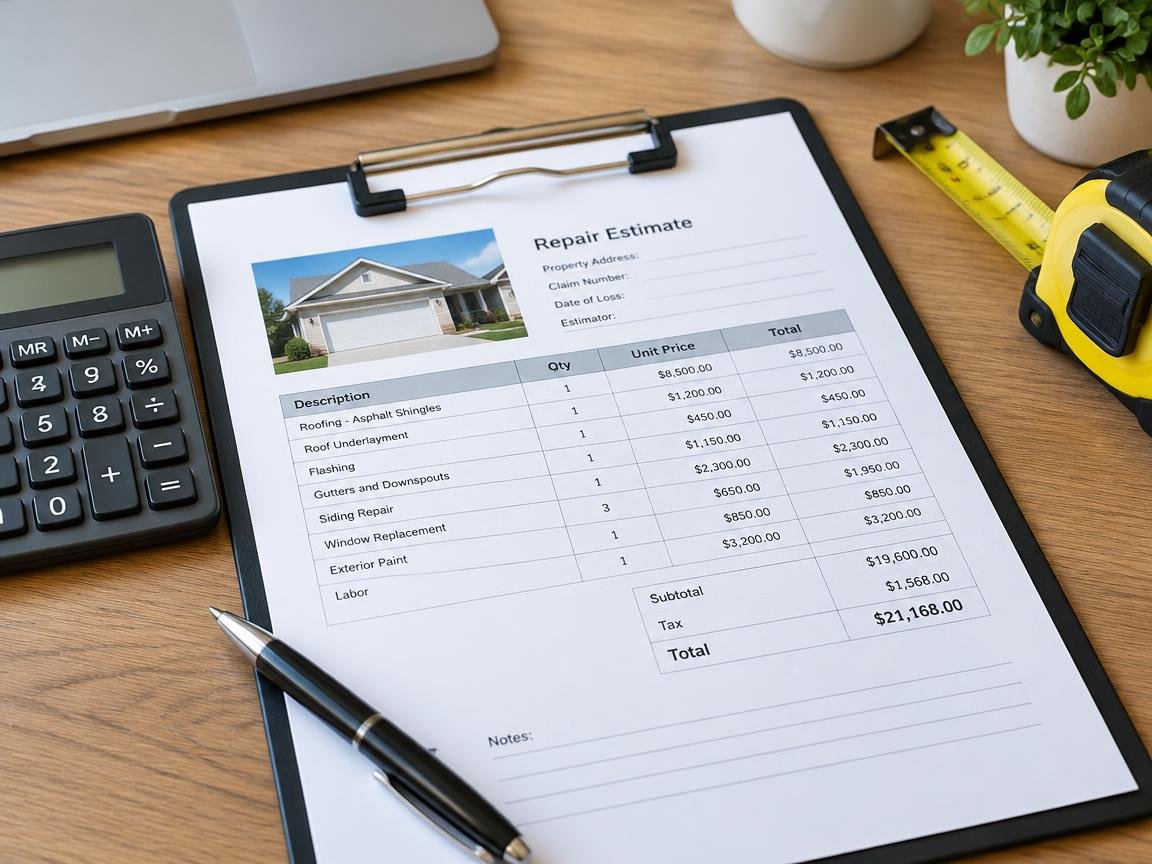
Once the cause and scope of damage are established, adjusters move to the estimation phase. This involves quantifying the cost of repairs or replacement. Modern claims adjusting heavily relies on specialized software that facilitates line-item estimating. These programs contain extensive databases of construction materials, labor costs, and repair methodologies, allowing adjusters to create detailed, itemized estimates.
Adjusters use unit pricing, which assigns a cost per unit of material or labor (e.g., cost per square foot of roofing, cost per hour of carpentry). This ensures consistency and fairness in estimates. They factor in material pricing, labor costs, and other expenses like waste, overhead, and profit. The goal is to determine either the replacement cost (RCV), which is the cost to replace the damaged property with new property of like kind and quality, or the actual cash value (ACV), which accounts for depreciation. Accurate estimation is a critical skill, requiring not only knowledge of construction but also proficiency with the estimating software.
Navigating the Claim Settlement and Documentation Lifecycle
The journey of a property damage claim extends beyond initial assessment to thorough claim documentation, negotiation, and ultimately, settlement. Throughout this lifecycle, meticulous record-keeping, photographic evidence, and careful consideration of contractor bids are essential. Adjusters guide policyholders through this process, which can include understanding depreciation recovery and reaching a fair settlement negotiation.
Immediate Steps When Filing Property Damage Insurance Claims
For policyholders, the moments immediately following property damage are critical. Adjusters often advise on these initial steps, which are crucial for both safety and the integrity of the claim. The first priority is loss mitigation: taking reasonable steps to prevent further damage. This might include boarding up broken windows, placing tarps on a damaged roof, or shutting off water to a burst pipe. These temporary repairs are often covered by policies and demonstrate the policyholder’s diligence.
Next, comprehensive documentation is key. Policyholders should create an inventory catalog of all damaged property, including descriptions, estimated age, and original cost if known. Crucially, photographic proof and video evidence of the damage before any repairs are made are indispensable. This visual record helps establish the date of loss and the extent of the damage. Adjusters rely on this initial documentation to corroborate their findings and streamline the claims process.
Common Pitfalls in Property Damage Insurance Claims
Even with careful planning, property damage claims can be fraught with challenges. Adjusters play a vital role in identifying and helping policyholders avoid common pitfalls. One significant issue is missed damage. Policyholders, unfamiliar with construction or structural issues, might overlook hidden damage that could lead to future problems if not addressed in the initial claim. Similarly, improper causation can derail a claim; if the policyholder or an inexperienced contractor misidentifies the cause of damage, it could lead to a denial.
Another common concern is lowball estimates. An initial estimate from an insurer might not fully account for all necessary repairs, quality materials, or local labor costs. This is where a public adjuster can be particularly beneficial, providing an independent damage appraisal. Missed deadlines are also a frequent problem, as policies often have specific timeframes for reporting claims or submitting documentation. Finally, overlooking the need for a structural inspection by a qualified professional, especially after severe events like earthquakes or significant wind damage, can lead to long-term safety issues and further claim disputes. Adjusters must be vigilant in ensuring all aspects of the damage are thoroughly investigated and accurately estimated.
Frequently Asked Questions About Property Damage Claims
Navigating property damage claims often brings up a host of questions for policyholders. Here, we address some of the most common inquiries, providing clarity on key concepts and processes.
What is the difference between Actual Cash Value (ACV) and Replacement Cost Value (RCV)?
This is one of the most fundamental distinctions in property insurance. Actual Cash Value (ACV) refers to the cost of replacing damaged property with new property of like kind and quality, minus depreciation. Depreciation accounts for factors like age, wear and tear, and obsolescence. When an insurer pays out an ACV claim, they are essentially providing the current market value of the damaged item.
Replacement Cost Value (RCV), on the other hand, is the cost to replace the damaged property with new property of like kind and quality without any deduction for depreciation. Most RCV policies involve a two-step payment process: an initial ACV payout, followed by a recoverable depreciation payment once the repairs are completed and proof of repair is submitted. This allows for full reimbursement for the cost of new materials and labor. Understanding this difference is crucial, as it directly impacts the amount of money a policyholder receives to rebuild or replace.
How long does an insurer have to process a property damage claim?
The timeframe within which an insurer must acknowledge, investigate, and pay out a property damage claim is largely governed by statutory timelines set by individual state insurance departments. While these can vary, most states require insurers to:
- Acknowledge receipt of a claim within a specific number of business days (often 10-15 days).
- Begin investigation and provide the policyholder with necessary forms within a similar timeframe.
- Make a decision on the claim (acceptance or denial) and notify the policyholder within a set period (e.g., 30-45 days) after receiving all requested information.
- Issue payment promptly once a claim is accepted and the settlement amount is agreed upon (often within 5-10 business days after agreement).
These periods can sometimes be extended under specific circumstances, such as during major catastrophes when the volume of claims is exceptionally high. Adjusters are responsible for adhering to these timelines and keeping policyholders informed throughout the process to ensure prompt payment and claim resolution.
What should I do if my property damage claim is denied or underpaid?
Receiving a denied or underpaid claim can be disheartening, but policyholders have several avenues to pursue.
- Review the Denial Letter Carefully: Understand the specific reasons cited by the insurer for the denial or the basis for the underpayment.
- Gather Additional Evidence: If the denial is based on insufficient documentation or a dispute over causation, gather more photographic evidence, expert reports (e.g., from a structural engineer), or contractor bids.
- Submit a Formal Dispute: Write a detailed letter to the insurer, outlining why you disagree with their decision and providing any new evidence.
- Invoke the Appraisal Clause: Many policies contain an “appraisal clause,” which allows both parties to hire independent appraisers to assess the damage. If they can’t agree, an umpire is brought in. This process can be binding.
- File a Supplemental Claim: If repairs reveal additional damage not initially assessed, a supplemental claim can be filed to cover these new findings.
- Contact Your State Insurance Department: State insurance departments regulate insurers and can assist with consumer complaints, mediate disputes, or investigate unfair practices.
- Consider a Public Adjuster: As discussed, a public adjuster can represent your interests, negotiate with the insurer, and help secure a fair settlement, especially in complex or disputed cases.
- Seek Legal Counsel: In some instances, consulting an attorney specializing in insurance law may be necessary.
It’s important to act promptly and keep thorough records of all communications and documentation throughout any dispute process.
Conclusion
Navigating property damage insurance claims can be a complex and often emotional experience for policyholders. From the initial loss mitigation and meticulous claim documentation to understanding policy nuances and negotiating settlements, every step requires careful attention. This is precisely where the expertise of a skilled insurance adjuster becomes invaluable.
Whether it’s a staff adjuster working directly for an insurer, an independent adjuster deployed during a catastrophe, or a public adjuster advocating solely for the policyholder, these professionals are crucial to ensuring fair and timely claim resolution. They interpret complex policy language, accurately assess damage using specialized tools, and guide all parties toward settlement finalization.
For aspiring adjusters, the path to a rewarding career involves understanding these distinct roles, acquiring essential skills, and committing to continuous learning. For policyholders, comprehending the process and knowing when to seek professional assistance can significantly impact their recovery. A successful outcome hinges on proper documentation, thorough policy comprehension, and effective communication, leading to the efficient execution of repairs and restoration of peace of mind.
